If you are looking at Fort Myers Beach real estate, flood risk is not a side issue. It is one of the first things you need to understand. Insurance costs, renovation plans, and even whether a home can be rebuilt as-is can all turn on flood-zone rules and elevation details. The good news is that with the right documents and guidance, you can make smarter decisions before you buy, sell, or rebuild. Let’s dive in.
Why flood zones matter here
On Fort Myers Beach, flood rules affect virtually every property. The Town states that the entire town is in the Special Flood Hazard Area, and FEMA’s updated flood maps for the area became effective on November 17, 2022. Those updates also added a Coastal A Zone and LiMWA area, both of which can affect design choices and flood insurance costs. You can review the Town’s flood guidance on the Fort Myers Beach flood information page.
The Special Flood Hazard Area is the 1% annual chance flood area. According to Lee County’s flood-zone definitions, A and V zones are considered high-risk flood zones, AE and VE zones include mapped base flood elevations, and VE is the coastal high-hazard area with wave action.
That distinction matters because if a parcel falls into more than one flood zone, the more restrictive zone applies. It also matters because flood zones help determine both construction standards and insurance requirements, and many mortgage lenders require flood insurance in A and V zones.
How to check a property’s flood status
Before you make an offer or list a property, confirm the flood zone and base flood elevation for the specific parcel. The Town recommends searching by full address in FEMA’s Map Service Center and reviewing the current map carefully. You can start with the Town’s flood information resources.
If you are planning to build, renovate, or significantly repair a home, the Town also recommends consulting a Florida-licensed engineer or architect along with a general contractor. That step can help you catch elevation or design issues before they become expensive surprises.
Flood insurance basics on Fort Myers Beach
One of the biggest misunderstandings in coastal real estate is assuming homeowners insurance covers flood damage. In most cases, it does not. The Town explains on its flood insurance page that standard homeowners insurance generally does not cover flooding.
A standard flood policy may help cover structural damage, debris cleanup, appliances and utilities, flooring, and contents. The same Town resource states that for a single-family home, NFIP coverage is capped at $250,000 for the structure and $100,000 for contents.
The Town also notes that government disaster help is not automatic after a flood and is often limited to declared disasters. In practical terms, that means flood insurance can be a core part of your risk planning, not a backup plan.
What drives flood insurance cost
Flood insurance pricing is no longer based only on the zone label. Under FEMA’s Risk Rating 2.0 approach, premiums are also shaped by property-specific factors such as:
- Distance to a water source
- Elevation
- Cost to rebuild
- Other property-level risk characteristics
That means two homes on Fort Myers Beach in the same general flood zone can still have very different premiums. For buyers, this is why it is important to ask about both the flood zone and the home’s elevation and documentation.
Why an Elevation Certificate matters
An Elevation Certificate, often called an EC, can be one of the most important documents in a coastal transaction. FEMA explains on its Elevation Certificate page that an EC helps insurers assess first-floor height and may help identify available discounts.
FEMA also notes that most homeowners do not need an EC to purchase flood insurance. However, in high-risk Zone A or Zone V areas, an EC may be needed to verify compliance with local floodplain requirements.
For Fort Myers Beach specifically, the Town requires the updated FEMA Elevation Certificate form for certificates signed on or after July 7, 2023. You can confirm that requirement on the Town’s Elevation Certificates page.
Rebuilding and the 50% rule
If a home on Fort Myers Beach has storm damage or is being heavily renovated, one of the biggest issues is the Town’s 50% rule. The Town’s substantial improvement and substantial damage guidance explains that if improvements or repairs equal or exceed 50% of the structure’s value, the building must be brought into full compliance with current floodplain standards.
This is where many owners get caught off guard. The Town counts all permits obtained in the past five years when calculating that threshold, not just the current repair estimate.
If repairs stay below that threshold, the Town may allow repair in place under its Post-Disaster Buildback Ordinance. That option generally depends on the structure having been legally built and permitted in the flood zone originally. The Town also notes that some historic structures may be exempt if compliance would threaten historic designation.
Elevation rules for new builds and major repairs
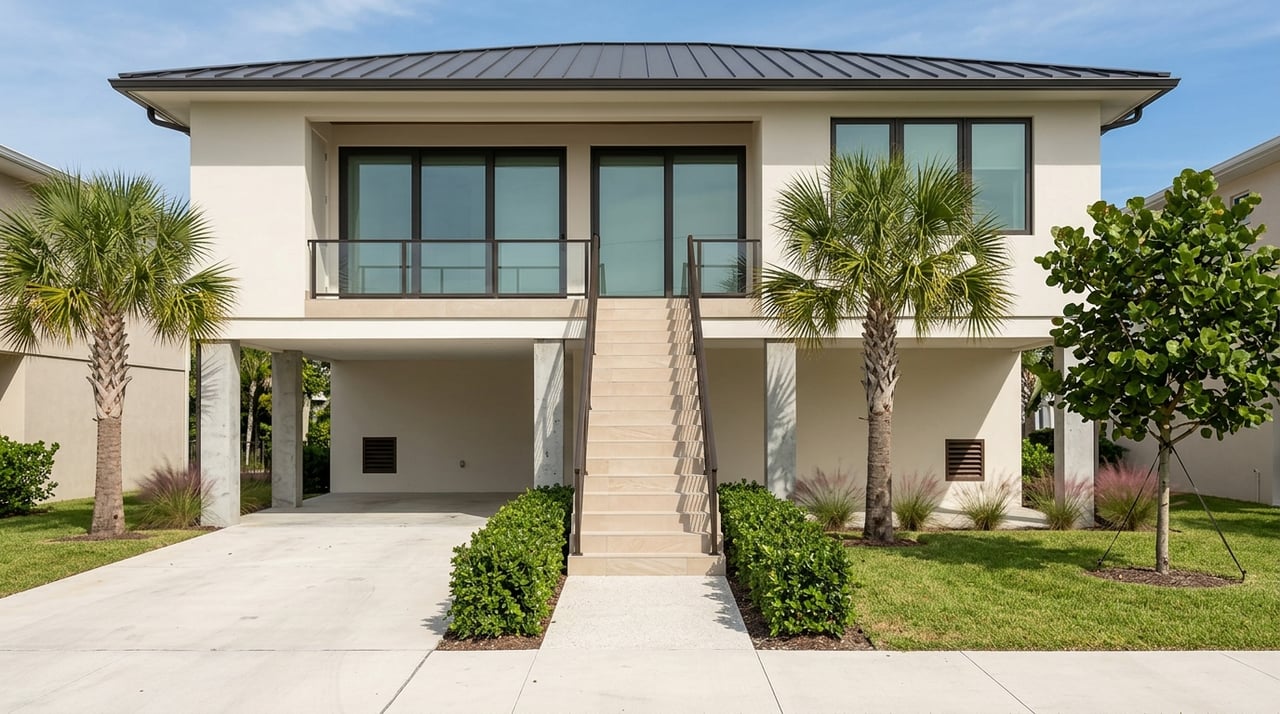
For new construction, substantial damage, or substantial improvement, Fort Myers Beach requires the lowest floor to be elevated to at least Base Flood Elevation plus 1 foot of freeboard. The Town’s FAQ page gives a simple example: if a property is in AE11, the lowest floor would need to be raised to 12 feet.
The way that lowest floor is measured also depends on the flood zone:
- In A zones, it is measured to the top of the lowest living floor
- In V zones, it is measured from the bottom of the lowest horizontal structural member
That is a critical difference for design, compliance, and cost. If you are comparing older homes, teardown opportunities, or homes that were partially repaired after storm damage, this detail can materially affect what comes next.
Current code and permit requirements
Code compliance is not static. Fort Myers Beach’s Resource Library lists the 2023 Florida Building Code, 8th Edition as effective for permits with application dates on or after December 31, 2023.
Florida law also provides that the code in effect on the permit application date governs the work for the life of the permit. Timing matters, especially for projects in progress or properties being sold mid-rebuild.
The Town’s Building Services page also states that contractors must have a state-issued license to perform work in Fort Myers Beach, and permits are processed through the Town’s system.
Coastal permitting issues to watch
On Fort Myers Beach, flood compliance is not always the only permitting hurdle. If work is proposed waterward of the Coastal Construction Control Line, or if the project includes beach fill or shoreline work, separate authorization may be required from both the Florida Department of Environmental Protection and the Town.
The Florida DEP explains on its Coastal Construction Control Line program page that the program is intended to protect beaches and dunes from poorly sited or designed structures. The Town also notes on its recovery guidance that fill waterward of the CCCL requires separate authorization.
For buyers and sellers, this is especially important when a property includes shoreline work, dune-facing conditions, or plans for reconstruction near the beach.
Can a home be floodproofed instead of elevated?
Sometimes owners ask whether floodproofing can be used instead of raising a home. On Fort Myers Beach, the answer is limited. The Town’s retrofitting and floodproofing guidance says floodproofing below Base Flood Elevation is not permitted for residential structures and is mainly a non-residential strategy.
That means residential owners generally need to think in terms of elevation, compliant rebuilding, and documentation rather than below-BFE floodproofing as a workaround.
A practical buyer and seller checklist
If you are evaluating a Fort Myers Beach property, these are the questions worth asking early:
- What flood zone and base flood elevation does the current FEMA map show?
- Does the parcel overlap more than one flood zone?
- Is there a current Elevation Certificate on file?
- If not, should a surveyor prepare one using the updated FEMA form?
- What flood insurance coverage is in place for the structure and contents?
- Could Increased Cost of Compliance apply if the property is substantially damaged?
- Would the current repair estimate, plus permits from the past five years, trigger the 50% rule?
- Is the home in an A zone or V zone, and how does that affect the elevation standard?
- Does the project require compliance with the 2023 Florida Building Code?
- Will the work require a state-licensed contractor, Town permits, or CCCL authorization?
Documentation can make a major difference
Fort Myers Beach repeatedly points owners back to records and proof. On the Town’s FAQ resources, it notes that photographs, diagrams, plans, affidavits, permits, appraisals, and tax records can all help establish prior legal construction and support a determination that a project is not substantially damaged.
That can be important whether you are buying a home that has already been repaired, selling a property with a storm history, or planning a rebuild. Good documentation can help clarify what was there before, what was legally permitted, and what may be allowed now.
One more insurance tool to know
If a flood loss leads to a substantial-damage determination, NFIP Increased Cost of Compliance coverage may provide up to $30,000 to help pay for required mitigation work such as elevation, demolition, relocation, or floodproofing. FEMA outlines that benefit on its Increased Cost of Compliance page.
This does not solve every rebuilding cost issue, but it is an important coverage feature to ask about when reviewing policies or planning next steps after major damage.
Bottom line for Fort Myers Beach buyers and sellers
On Fort Myers Beach, affordability is about more than asking price. The real cost of ownership can also depend on flood zone details, elevation, insurance pricing, code compliance, and coastal permitting. If you understand those factors early, you can avoid surprises and make more confident decisions.
If you are buying, selling, or weighing a rebuild on the beach, working with someone who understands the moving parts can save you time and help you ask better questions from day one. If you want practical guidance on coastal property decisions in Southwest Florida, connect with Heather Porrett.
FAQs
What flood zone issues should Fort Myers Beach buyers check first?
- Buyers should confirm the current FEMA flood zone, the base flood elevation, and whether the parcel falls into more than one zone, since the more restrictive zone applies.
What does flood insurance usually cover on Fort Myers Beach?
- According to the Town, a standard flood policy may cover structural damage, debris cleanup, appliances and utilities, flooring, and contents, with single-family coverage capped at $250,000 for the structure and $100,000 for contents.
What is the 50% rule for rebuilding on Fort Myers Beach?
- If repairs or improvements equal or exceed 50% of the structure’s value, the building must be brought into compliance with current floodplain standards, and the Town counts permits from the past five years toward that calculation.
What elevation standard applies to Fort Myers Beach rebuilds?
- For new construction and substantially damaged or improved buildings, the Town requires the lowest floor to be elevated to at least Base Flood Elevation plus 1 foot of freeboard.
What documents help with Fort Myers Beach rebuilding decisions?
- Helpful records can include Elevation Certificates, permits, plans, photos, diagrams, appraisals, affidavits, tax records, and other proof of prior legal construction.
What permits might a Fort Myers Beach coastal project need?
- Depending on the work, a project may need Town permits, a state-licensed contractor, and possibly separate authorization for work waterward of the Coastal Construction Control Line or for beach fill and shoreline work.